


How to Build a Branded Merchandise Strategy
That Actually Works
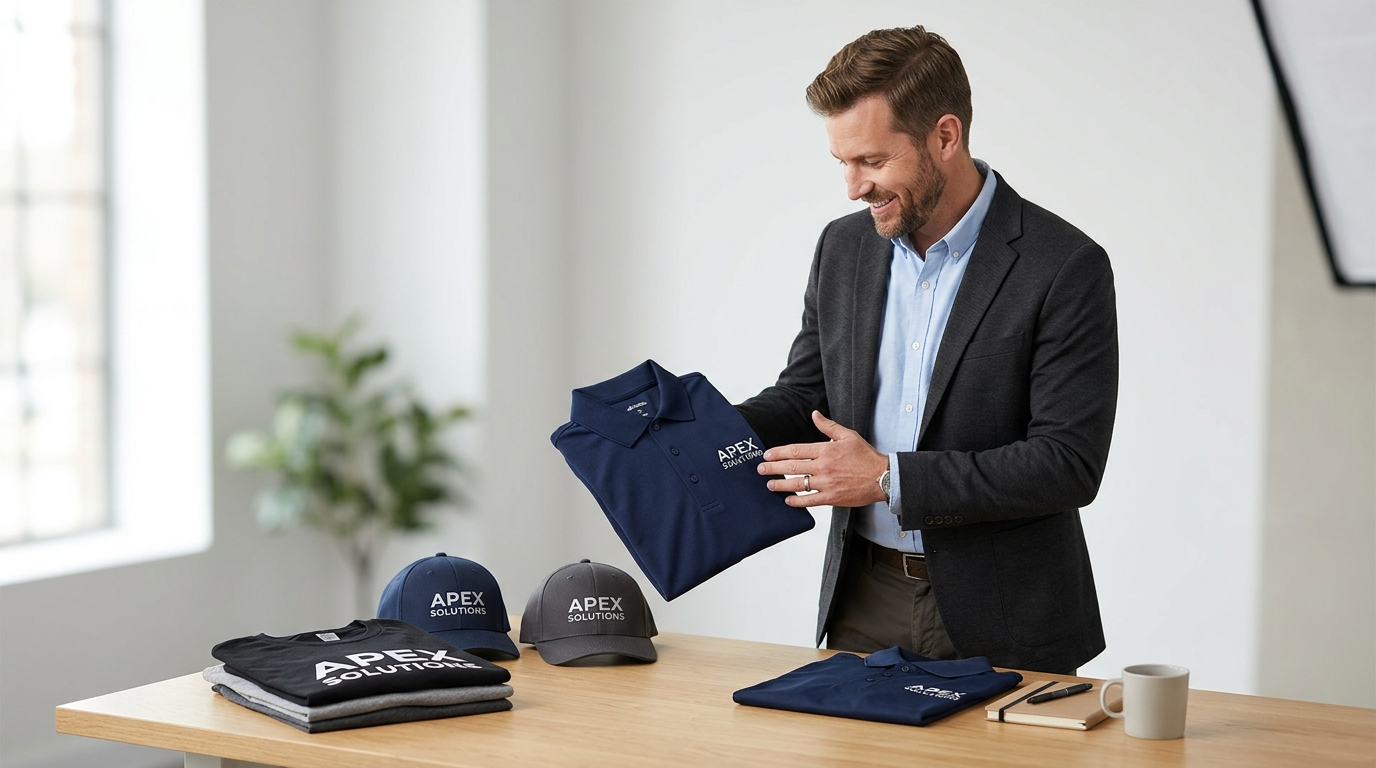
Most businesses that order branded merchandise treat it like a one-time transaction. They need shirts for an event or hats for the team, they place an order, and they move on. That approach works fine for a single occasion. But it doesn't build a brand. A real branded merchandise strategy does something different: it turns every piece you produce into a consistent, intentional extension of what your business stands for.
Why Most Branded Merchandise Doesn't Work
The most common complaint we hear from businesses about their branded merchandise is some version of: "We spent money on it and nothing really came of it." The shirts sat in a closet. The hats never got worn. The employees didn't want to represent the brand because the product wasn't something they'd choose to wear on their own.
The problem usually isn't the product itself. It's that the order happened without a strategy behind it. There was no clear purpose, no defined audience, and no standard for what the finished product needed to accomplish. The result was a box of branded items that didn't connect to anything.
The core issue: Merchandise without purpose is just inventory. A branded merchandise strategy turns apparel and promotional items into touchpoints that reinforce your identity every time someone sees them, wears them, or hands them to someone else.
Start With Purpose - Know Why Before You Order Anything
Before you decide what to order, you need to answer one question honestly: what do you want this merchandise to do? The answer shapes every other decision you make, from the product type to the production method to the quantity.
- 01Team identity and uniform programs. You want your employees to look consistent and professional in the field, at events, or in client-facing roles. The priority here is durability, wearability, and logo clarity. People will wear these items regularly, so quality matters more than novelty.
- 02Client gifting and retention. You want to give clients something they'll actually use and appreciate. The goal is connection, not just promotion. Items that feel premium - a well-constructed hat, a quality jacket, a polished polo - do this. Cheap giveaways do the opposite.
- 03Event presence and brand awareness. You want to show up at an event with something people want to take home. Here, design and visual appeal matter as much as quality. A shirt people want to wear after the event is working for you long after the event ends.
- 04Revenue-generating merchandise. You're building a product line - branded apparel your audience will actually buy. This requires treating the merchandise like a product: design quality, fit, color options, and price point all factor in. See our post on how InkWorx helps companies build a consistent brand image for how this fits into a longer-term program.
These goals aren't mutually exclusive, but they have different implications for what you order and how you produce it. Get clear on your primary purpose before you make any other decisions.
Choosing the Right Items for Your Brand
Once you know why you're ordering, choosing what to order becomes significantly easier. The question isn't "what's popular?" - it's "what fits the purpose and actually represents the brand well?"
Here's a simple framework for evaluating any merchandise item:
- Will the intended recipient actually use or wear this? If not, don't order it.
- Does the item quality match the impression you want to make? Low-quality items carry a message too.
- Does the decoration method work for your logo? Some logos don't translate well to certain methods - embroidery handles complex fine-line artwork differently than screen printing does.
- Is this something you can reorder consistently? Building brand recognition requires consistency, not a different item every time.
- Does the item fit into your broader visual identity - colors, positioning, the overall look of your brand?
The goal is to narrow the list down to a small number of items you can execute well and reorder reliably. A brand with three consistently great products will outperform one with fifteen inconsistent ones.
builds more brand than ten mediocre ones.
Getting the Details Right So Your Merch Looks as Good as Your Brand
This is where most branded merchandise falls apart. The concept is right, the product is right, but the execution doesn't match the brand standard. Colors are off. The logo is too small or in the wrong position. The print method wasn't chosen to match the artwork. The result looks branded, but it doesn't look good.
Match the production method to the artwork. Embroidery excels at structured logos with clean lines and limited colors. Screen printing handles flat, bold graphics at high volume. DTG is ideal for photorealistic or complex multicolor designs with no minimums. Choosing the wrong method for your artwork creates a disconnect between what the design looks like digitally and what it looks like on a garment. Our post on embroidery vs. screen printing breaks this down in detail if you're weighing options.
Specify colors in Pantone values. If your brand has specific colors, they need to be specified as Pantone values - not described verbally, not referenced from a screen. Screens display color differently than fabric does, and different substrates absorb color differently. Locking in the Pantone reference removes the ambiguity before it becomes a problem.
Think about placement and proportion. A logo that works on a business card doesn't automatically work at every size and placement on a garment. Test how your logo looks at different dimensions before finalizing the spec. Left chest is standard for a reason - it's legible without being overwhelming. Full-back and full-front prints have different rules. Work through the placement with your production partner before approving the proof.
For a broader look at what separates brands that look polished from ones that don't, read what actually makes a brand look professional.
From Idea to Apparel Brand
Our complete production framework covers artwork requirements, garment selection, decoration methods, and the pre-production checklist we use on every serious project.
Get the Production Guide →Making Your Merchandise Budget Work Harder
Order smarter quantities, not just more. Higher quantities lower your per-unit cost, but ordering more than you need isn't saving money - it's spending money on items that will sit unused. A well-planned order of the right quantity beats a cheap bulk order that half goes to waste.
Prioritize items that travel. Apparel is one of the highest-ROI branded items because it moves. Every time someone wears your shirt outside your building, they're advertising your brand. Prioritize wearable items over items that stay on a desk or in a drawer.
Build a repeatable program, not a one-time order. The brands that get the most value from custom apparel aren't the ones that place one large order every few years. They're the ones that build a consistent program: a core set of approved items, a standard spec, and a reorder cadence. That consistency is what builds recognition over time.
The practical goal: By the end of this process, you should be able to answer three questions: What are we ordering? Why are we ordering it? And how will we reorder it consistently? If you can't answer all three, the strategy isn't done yet.
Frequently Asked Questions
How much should I budget for a branded merchandise program?
It depends on the program's purpose and scale, but most businesses starting a branded merchandise program should plan for a minimum viable run on one or two core items rather than spreading a small budget across many products. A focused $500 to $1,500 investment in one well-chosen item executed correctly will build more brand value than the same budget spread across five mediocre products. As you scale, you add items - not replace them.
What's the best item to start with for a branded merchandise program?
The best starting item is the one your audience will actually wear or use in public. For most business-to-business companies, that's a high-quality polo or crew neck. For consumer-facing brands, it's often a well-designed t-shirt or structured hat. Start with one item, get the spec right, and build from there. Don't try to launch a full product line on a first order.
How do I make sure my merch actually looks professional?
Three things matter most: the quality of the blank (the garment before decoration), the quality of the decoration method for your artwork, and having your artwork in the correct format for production. Work with a production partner who asks about your artwork and your brand standards before quoting - not one who takes any file and runs with it. The proof review step exists for a reason: use it to verify colors, sizing, and placement before approving production.
Can I order small quantities and still have professional-looking results?
Yes - particularly with DTG and DTF printing, which have no minimums and produce full-color results on single pieces. Screen printing has minimum quantities because the setup cost per color is fixed, but for lower-volume needs, DTG or DTF can produce high-quality results without the minimums. The right method depends on your artwork and quantity. Request a quote and we'll recommend what makes sense for your specific project.
How often should I update or change my branded merchandise?
Resist the urge to change too frequently. Brand recognition is built through consistency, not novelty. If your core visual identity is stable, your branded merchandise should stay largely the same from year to year - updating for quality improvements, colorway additions, or garment style changes, but not redesigning the program every season. Change when there's a real reason to change, not because you're bored with it.
Start With a Quote
Tell us about your project - what you're trying to accomplish, roughly how many pieces, and what your timeline looks like. We'll review your artwork, ask the right questions, and come back with honest options.
Request a Quote →We respond within 24 hours. No commitment required.